Some rainy days are cosy. The rest are a slow negotiation with small people who have already watched their allotted screen time and are now circling the kitchen like sharks. On those days, the tub of magnetic tiles earns its keep, but only if you have a few ideas ready to go, because “just build something” lands about as well as “just relax” does on a toddler.
Here are twelve builds that actually work, sorted by age, plus how to keep the peace when three kids want one set, and how to get it all packed away without tears. Yours or theirs.
18 months to 2 years: stack, crash, repeat
At this age the game is cause and effect, and the tiles are basically indestructible blocks that happen to click together.
- Tower and crash. You build the tower, they demolish it. That is the whole game, and it is a banger. Count the tiles out loud as you stack so some sneaky early numbers ride along with the chaos.
- Fridge gallery. Magnetic tiles stick to the fridge and the dishwasher door, which turns your kitchen into a vertical play mat. Hand over a stack and let them arrange flat patterns at toddler height while you cook. This one buys you twenty minutes, which in toddler currency is a fortnight.
- Peekaboo box. Build a simple cube around a small toy while they watch, then let them pull it apart to “find” it. Hide, open, shriek, rebuild. Object permanence has never been this loud.
3 to 4 years: little worlds
Preschoolers stop stacking and start storytelling. The tiles become scenery.
- Car garage. A row of open-fronted boxes, one per toy car, and suddenly there is a parking structure with strict allocation rules only a four-year-old understands. Add a ramp off the couch cushion for the full experience.
- Colour roads. Lay tiles flat in long lines and sort by colour as you go: a red road, a blue road, a rainbow highway. It is pattern-making dressed up as roadworks, and it sneaks in sorting and sequencing without a worksheet in sight.
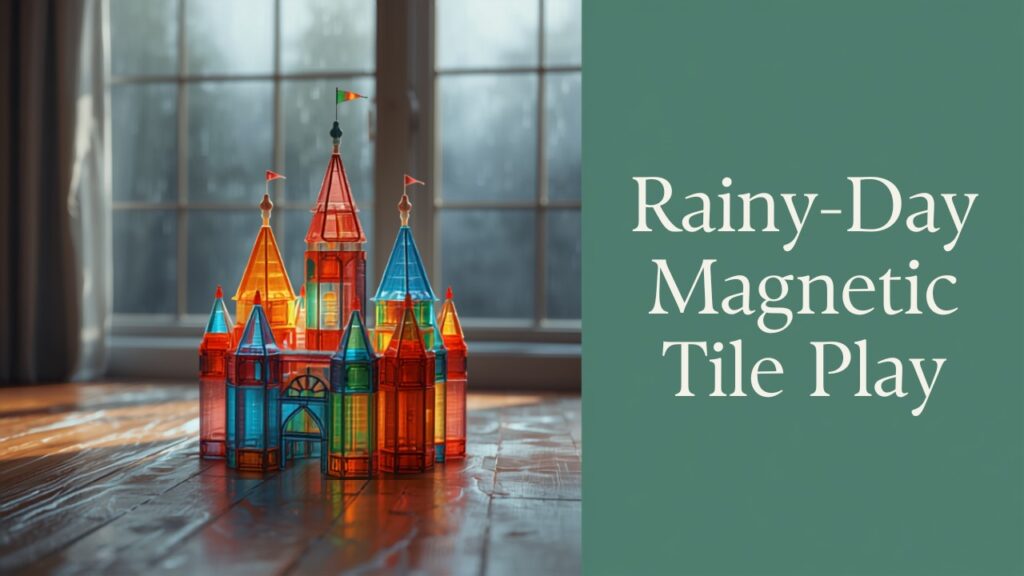
- Window sun-catchers. On the one bright hour of a rainy day, stick translucent tiles to a window and watch the coloured light land on the floor. Torches work after dark. This is the closest a toy comes to actual magic before age five.
5 to 7 years: engineers in training
This is the golden age of magnetic tile play, when kids discover that six squares fold into a cube and everything changes.
- Ball run. Angle tiles into ramps down the stairs or off a stack of books and send a ball down the course. Then comes the tinkering: why does it fly off the corner, and what fixes it? That is iteration, the actual job of an engineer, happening on your hallway floor.
- Zoo enclosures. Every plastic animal in the house gets a paddock. The giraffe needs high walls, the snake needs a lid, and the escaped lion is a plot point, not a design failure.
- The flat-to-3D challenge. Lay out a cross shape of six squares and ask, “Can you turn this into a box without pulling it apart?” Watching a six-year-old work out that a flat net folds into a cube is genuinely great viewing. It is also early geometry, but you do not need to tell them that.
8 and up: the challenge era
Big kids will tell you they are too old for tiles, then spend two hours trying to beat their own bridge record.
- Bridge span contest. Two chairs, a gap, and one question: how far can you bridge before it sags and drops? Move the chairs apart round by round. Add a toy car as cargo for extra stakes.
- Copy the landmark. Pull up a photo of the Eiffel Tower, a pyramid or your own house and challenge them to build it. Translating a photo into a structure is proper spatial reasoning, and the failed attempts are half the fun.
- Stop-motion film set. Tiles make fast, rebuildable sets for stop-motion videos on a tablet or phone. Castle scene, demolition scene, alien invasion scene. This one merges screens and building, which on a long wet weekend is not a compromise, it is a strategy.
One set, three kids, zero bloodshed
You do not need a set per child. A few things help:
- Split by colour, not by count. Each kid gets their colours and their patch of floor. Disputes drop instantly because ownership is visible at a glance.
- Assign roles on big builds. One architect, one builder, one supplier who ferries tiles. Rotate every ten minutes. The toddler is always the demolition department, and honestly they are the best at it.
- Run challenges instead of sharing. Same brief, separate builds, then a walk-around judging ceremony. Everybody wins something (“most creative door”) because you are the judge and you are not silly.
A bigger tub helps too. If the collection needs topping up, Australian brand Miniblox sells magnetic tiles in packs sized for exactly this problem, and because standard tiles click together across sets, new pieces just fold into the existing stash.
Pack-down without the meltdown
The tidy-up is playable too. “Magnet fishing” is the reliable one: hand each kid a tile and have them pick up the scattered pieces by clicking them into a stack, biggest stack wins. Sort-by-colour into the tub works as a wind-down for littlies.
Store the lot in a shallow tub or a drawstring bag rather than a deep toy box, so tiles stay visible and get chosen tomorrow instead of buried. And keep the tub away from laptops and hard drives, because magnets and electronics are not friends.
One last honest note: of all the toys that survive the rotation cull in our house, magnetic blocks are the ones every age still reaches for. The builds change, the tub stays. On a rainy Tuesday in the school holidays, that is worth more than any single-purpose toy on the shelf.